

There’s plenty of disagreement on the best ways to teach and learn. So I got curious about where researchers actually agree. What research findings are replicated and rock-solid?
This list is mostly inspired by Daniel Willingham’s poorly-named “Why Don’t Students Like School?”. After a brief attempt at answering the title question in the first chapter, most of the book is actually an overview of some of the most durable results in cognitive psychology. This is my summary of those principles, minus one that aged poorly1, plus a few additions that didn’t make his list but have very solid support in research over time.
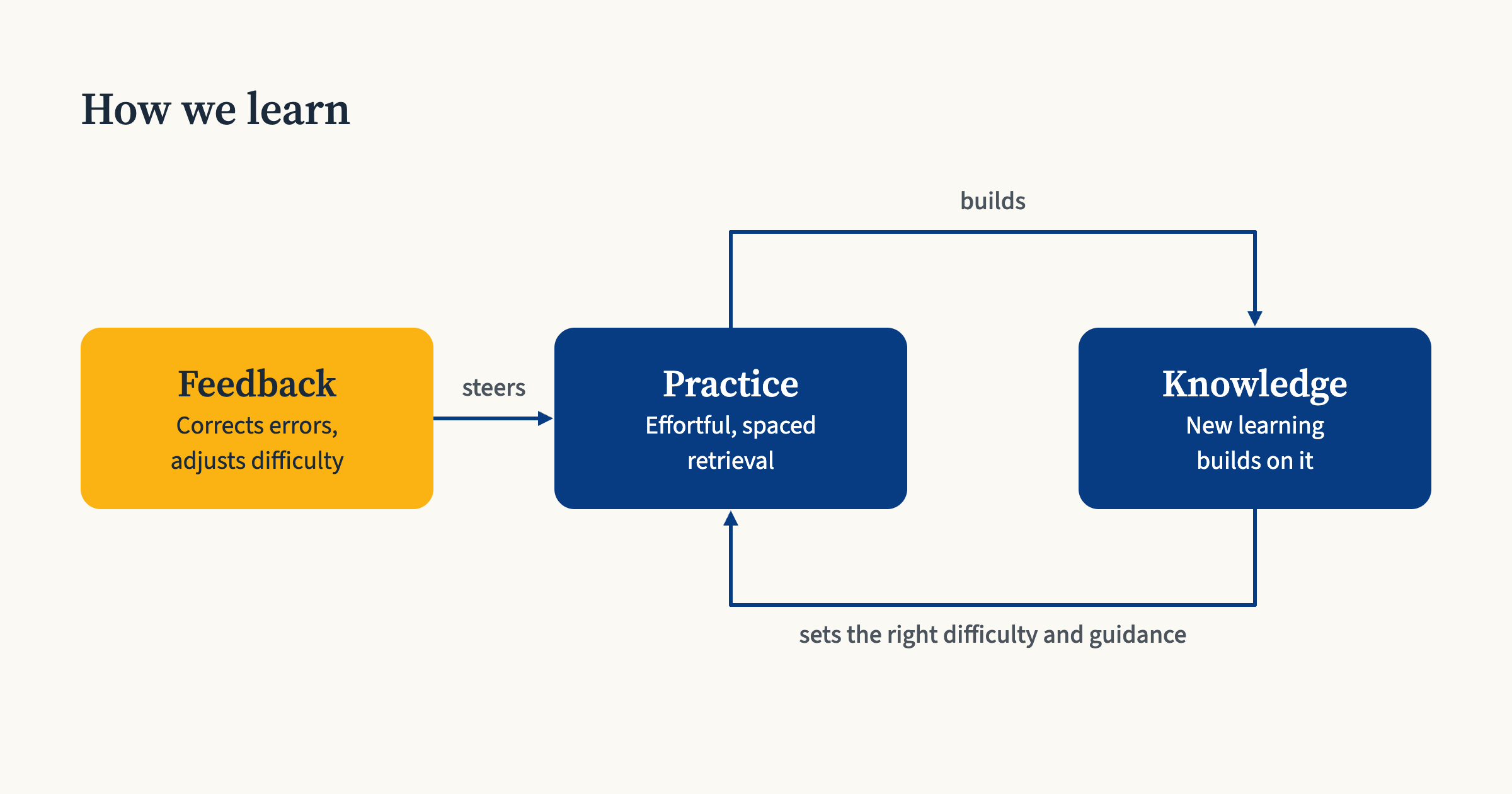
It turns out that much of the research tells us that three things are important: practice, feedback and what you already know. The headings sound obvious, and that’s a good thing.
(1) Practice matters
“Memory is the residue of thought”, as Daniel Willingham wrote.2 Cognitive psychology research has shown that we remember what we think about.3
Proficiency requires extended practice.4 This makes basic thinking automatic, which frees up working memory for more complex thinking.5
Retrieval practice spaced out over time beats simple re-reading.6 Learning takes work over time, not just staring at the page.7 Cramming does typically work for an exam the next day, but is worse for long-term recall.8
(2) Feedback matters
Mental effort is costly by default.9 And learners tend to drift towards practice that feels easy.10 So the right level of difficulty for each learner should be set from the outside.11
Novices often misjudge the quality of their own work.12 So outside feedback is needed to assess progress.13
Corrective information after an error improves learning.14 Feedback helps when it’s about the task.15 Some feedback has been shown to have a negative effect on learning, possibly because it is about the person, or distracts from practice.16
(3) Prior knowledge matters
We understand new things through what we already know.17 In other words, learning is cumulative.18
Skilled thinking depends on well-organized domain knowledge.19 Generic critical thinking skills cannot substitute for knowledge of the subject.20
I omitted the claim that mindset and effort can improve intelligence. The support for this is more mixed.
Willingham, D. T. (2009). Why Don’t Students Like School? Jossey-Bass, ch. 3 (2nd ed., 2021).
Craik, F. I. M., & Lockhart, R. S. (1972). Levels of processing: A framework for memory research. Journal of Verbal Learning and Verbal Behavior, 11(6), 671–684. Hyde, T. S., & Jenkins, J. J. (1973). Recall for words as a function of semantic, graphic, and syntactic orienting tasks. Journal of Verbal Learning and Verbal Behavior, 12(5), 471–480.
Ericsson, K. A., Krampe, R. T., & Tesch-Römer, C. (1993). The role of deliberate practice in the acquisition of expert performance. Psychological Review, 100(3), 363–406. Practice is necessary but not sufficient: Macnamara, B. N., Hambrick, D. Z., & Oswald, F. L. (2014). Deliberate practice and performance in music, games, sports, education, and professions: A meta-analysis. Psychological Science, 25(8), 1608–1618.
Shiffrin, R. M., & Schneider, W. (1977). Controlled and automatic human information processing: II. Perceptual learning, automatic attending, and a general theory. Psychological Review, 84(2), 127–190. LaBerge, D., & Samuels, S. J. (1974). Toward a theory of automatic information processing in reading. Cognitive Psychology, 6(2), 293–323. Sweller, J. (1988). Cognitive load during problem solving: Effects on learning. Cognitive Science, 12(2), 257–285.
Roediger, H. L., & Karpicke, J. D. (2006). Test-enhanced learning: Taking memory tests improves long-term retention. Psychological Science, 17(3), 249–255. Cepeda, N. J., Pashler, H., Vul, E., Wixted, J. T., & Rohrer, D. (2006). Distributed practice in verbal recall tasks: A review and quantitative synthesis. Psychological Bulletin, 132(3), 354–380. Dunlosky, J., Rawson, K. A., Marsh, E. J., Nathan, M. J., & Willingham, D. T. (2013). Improving students’ learning with effective learning techniques: Promising directions from cognitive and educational psychology. Psychological Science in the Public Interest, 14(1), 4–58.
Callender, A. A., & McDaniel, M. A. (2009). The limited benefits of rereading educational texts. Contemporary Educational Psychology, 34(1), 30–41. On students’ preference for rereading: Karpicke, J. D., Butler, A. C., & Roediger, H. L. (2009). Metacognitive strategies in student learning: Do students practise retrieval when they study on their own? Memory, 17(4), 471–479.
Rawson, K. A., & Kintsch, W. (2005). Rereading effects depend on time of test. Journal of Educational Psychology, 97(1), 70–80. Kornell, N. (2009). Optimising learning using flashcards: Spacing is more effective than cramming. Applied Cognitive Psychology, 23(9), 1297–1317.
Kool, W., McGuire, J. T., Rosen, Z. B., & Botvinick, M. M. (2010). Decision making and the avoidance of cognitive demand. Journal of Experimental Psychology: General, 139(4), 665–682. David, L., Vassena, E., & Bijleveld, E. (2024). The unpleasantness of thinking: A meta-analytic review of the association between mental effort and negative affect. Psychological Bulletin, 150(9), 1070–1093. For a critique arguing the meta-analysis measured task difficulty rather than effort: Grund, A., Roelle, J., & Schmid, S. (2026). Is thinking inherently unpleasant? A cautionary note on David, Vassena, and Bijleveld (2024). Psychological Bulletin, 152(2), 201–206.
Kornell, N., & Bjork, R. A. (2008). Learning concepts and categories: Is spacing the “enemy of induction”? Psychological Science, 19(6), 585–592. Kirk-Johnson, A., Galla, B. M., & Fraundorf, S. H. (2019). Perceiving effort as poor learning: The misinterpreted-effort hypothesis of how experienced effort and perceived learning relate to study strategy choice. Cognitive Psychology, 115, 101237.
Inference from notes 9 and 10. On “desirable difficulties”: Bjork, R. A. (1994). Memory and metamemory considerations in the training of human beings. In J. Metcalfe & A. Shimamura (Eds.), Metacognition: Knowing about knowing (pp. 185–205). MIT Press.
Dunning, D., Heath, C., & Suls, J. M. (2004). Flawed self-assessment: Implications for health, education, and the workplace. Psychological Science in the Public Interest, 5(3), 69–106. Bjork, R. A., Dunlosky, J., & Kornell, N. (2013). Self-regulated learning: Beliefs, techniques, and illusions. Annual Review of Psychology, 64, 417–444.
Inference from the notes 10 and 12. See also Shute, V. J. (2008). Focus on formative feedback. Review of Educational Research, 78(1), 153–189.
Pashler, H., Cepeda, N. J., Wixted, J. T., & Rohrer, D. (2005). When does feedback facilitate learning of words? Journal of Experimental Psychology: Learning, Memory, and Cognition, 31(1), 3–8. Butler, A. C., & Roediger, H. L. (2008). Feedback enhances the positive effects and reduces the negative effects of multiple-choice testing. Memory & Cognition, 36(3), 604–616. Metcalfe, J. (2017). Learning from errors. Annual Review of Psychology, 68, 465–489.
Hattie, J., & Timperley, H. (2007). The power of feedback. Review of Educational Research, 77(1), 81–112. Wisniewski, B., Zierer, K., & Hattie, J. (2020). The power of feedback revisited: A meta-analysis of educational feedback research. Frontiers in Psychology, 10, 3087.
Kluger, A. N., & DeNisi, A. (1996). The effects of feedback interventions on performance: A historical review, a meta-analysis, and a preliminary feedback intervention theory. Psychological Bulletin, 119(2), 254–284. More than a third of feedback interventions reduced performance. Note that this meta-analysis measured performance, not learning specifically.
Bransford, J. D., & Johnson, M. K. (1972). Contextual prerequisites for understanding: Some investigations of comprehension and recall. Journal of Verbal Learning and Verbal Behavior, 11(6), 717–726. Recht, D. R., & Leslie, L. (1988). Effect of prior knowledge on good and poor readers’ memory of text. Journal of Educational Psychology, 80(1), 16–20.
Willingham, D. T. (2006). How knowledge helps: It speeds and strengthens reading comprehension, learning—and thinking. American Educator, 30(1). Simonsmeier, B. A., Flaig, M., Deiglmayr, A., Schalk, L., & Schneider, M. (2022). Domain-specific prior knowledge and learning: A meta-analysis. Educational Psychologist, 57(1), 31–54. Prior knowledge strongly predicts later knowledge, though not, on average, the size of learning gains. Witherby, A. E., & Carpenter, S. K. (2022). The rich-get-richer effect: Prior knowledge predicts new learning of domain-relevant information. Journal of Experimental Psychology: Learning, Memory, and Cognition, 48(4), 483–498.
Chase, W. G., & Simon, H. A. (1973). Perception in chess. Cognitive Psychology, 4(1), 55–81. Chi, M. T. H., Feltovich, P. J., & Glaser, R. (1981). Categorization and representation of physics problems by experts and novices. Cognitive Science, 5(2), 121–152.
Willingham, D. T. (2007). Critical thinking: Why is it so hard to teach? American Educator, 31(2), 8–19. Gick, M. L., & Holyoak, K. J. (1980). Analogical problem solving. Cognitive Psychology, 12(3), 306–355. Teaching critical thinking does produce modest gains, mostly when it’s embedded in subject content: Abrami, P. C., Bernard, R. M., Borokhovski, E., Waddington, D. I., Wade, C. A., & Persson, T. (2015). Strategies for teaching students to think critically: A meta-analysis. Review of Educational Research, 85(2), 275–314.