

In the early days of ChatGPT, I downplayed the positive impact AI would have on education. After all, hadn’t nearly all the world’s knowledge been on the internet for more than a decade? Wikipedia, YouTube, and massive open online courses (MOOCs) covered nearly any topic you might want to learn about. That helped lots of motivated individual learners, but it didn’t produce any systemic improvements in education.
The simplest explanation for why the internet didn’t transform overall learning outcomes is the one Justin Reich offers in Failure to Disrupt: even with ubiquitous knowledge, learning still requires motivation and effort. Today, many “AI will improve education” claims are just internet-era claims, reformulated.
Here’s what’s different this time: AI makes learning optional for productivity.
The motivated individual learner is the one success story of the MOOC era, and AI is breaking it. In a previous essay, I wrote about how AI is making it harder for schools to assess learning. This one is about how AI is hurting self-directed learners too.
In the pre-AI days, if you didn’t learn the tool, you couldn’t build the thing. Wanting to build the thing was the motivation that made you learn the tool. But today, AI can build the thing for you. The learning part is now optional. AI cuts the motivational link between learning and productivity in a way that the internet never did.
Paul Graham makes this observation about writing in his essay Writes and Write-Nots. He predicts the world will split into those who choose to write and those who never do, because AI makes writing skills optional. But it applies to more than just writing. It applies to any self-driven creative pursuit. You used to hit a wall trying to make something, and you’d have to learn your way past it. Now, AI can unblock you, so you have to decide where to pause and actually learn.
No previous generation of self-directed learners has had this much choice. Before, if you wanted to build software, you had to study math and programming, and you probably didn’t have time to also be a social scientist. If you wanted to build new models of human behavior, you had to read about the previous attempts, and learn statistics and experimental design, and you probably didn’t have time to build software. The prerequisites are now mere suggestions.
You can build the app this afternoon, then make the behavioral model, and be done before dinnertime. The output is free now. But learning still takes time and effort. AI accelerated productivity but didn’t accelerate learning. So you have to decide which skills are still worth learning, and which you can fast-forward past.
The research on the productivity-learning split is clear: unconstrained AI use produces students who score better on the AI-assisted assignment (“accelerated productivity”), but then score worse on an AI-free exam (“didn’t accelerate learning”). A 2024 Wharton study by Bastani et al. reached this conclusion, and so did a 2026 Stockholm University study by Strömberg et al., which produced this chart.
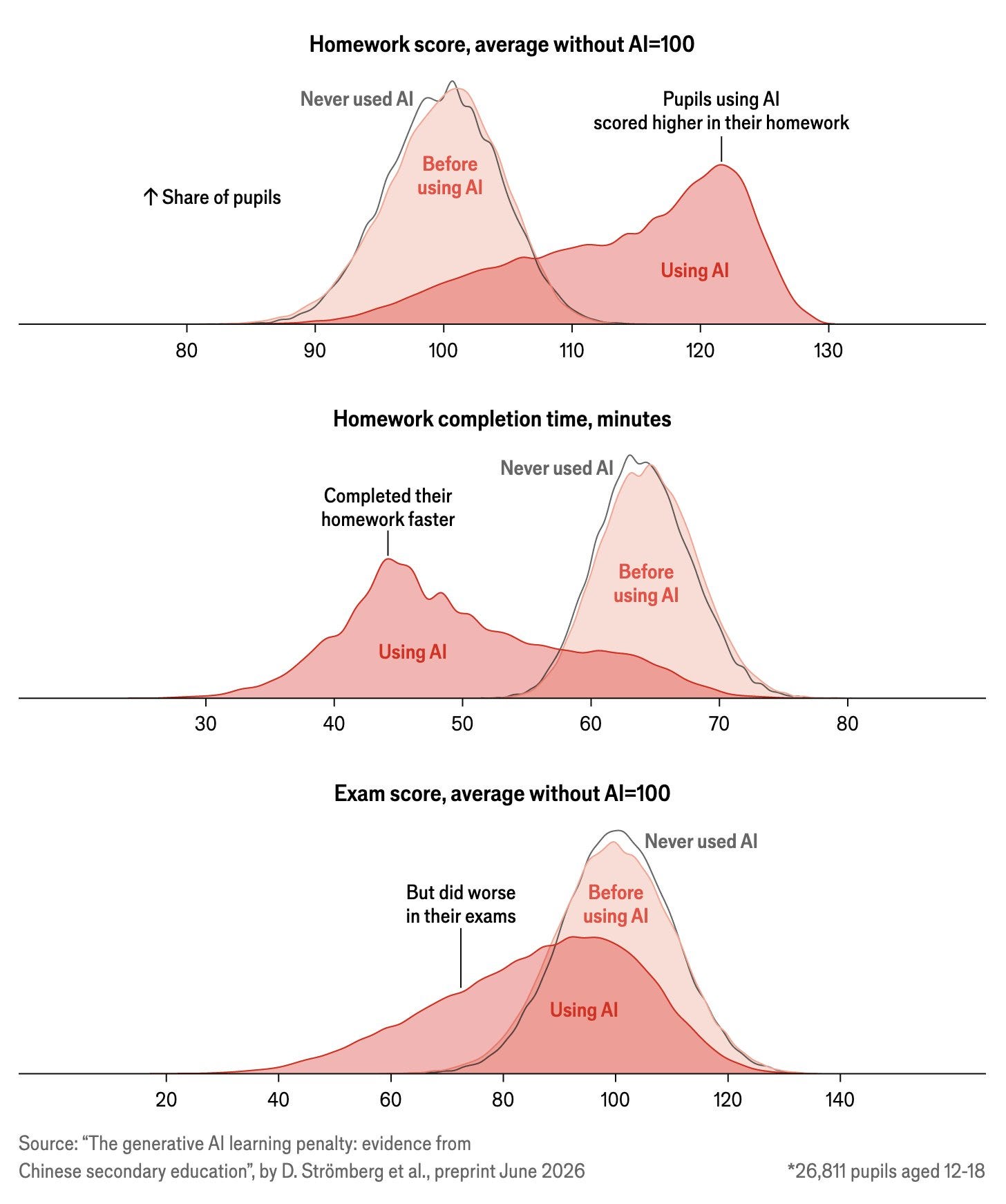
These studies are from schools, but the effect applies beyond the classroom. If you skip the effort, you skip the learning.
But why even bother learning something the AI knows? Because you need to understand a concept to be able to think about it yourself, and have the next idea.
It’s fashionable among the AI-pilled to say that you just need the higher-level concepts now that AI can do everything. If they traveled a couple of generations back in time, these same people would be saying that you don’t need to learn multiplication because a calculator can do it. Of course, the calculator is faster. The point is to train your brain. You can outsource the multiplication after you understand it. To understand the concepts that sit above multiplication, like area in geometry, the multiplication needs to be automatic.
Learn the things you want to be able to have ideas about. And then feel free to collect your AI productivity dividend on the rest of it. The people actually building the models at OpenAI and Anthropic? I bet they know how to multiply numbers without a calculator.